business planning 101

Business plans have a bad rep these days.  I’m not sure what happened.  Maybe they let themselves go, piled on a few pounds and stopped returning calls…

I suspect that the issue lies with the idea of what a business plan should be (dense and serious) and what it should contain (lots of dry facts and figures, a liberal sprinkling of pie charts).

Whatever the reason, whenever I talk to someone about their fledgling business, nothing gets me stonewalled quicker than asking them how they put their business plan together.  Particularly in the tech or creative sectors.  Business plans are seen as old-school, flabby and a waste of time that could be spent creating an amazing viral campaign.

Well, call me old-fashioned and pour me a sherry, but I’m pretty certain that they still have their place.  I’ve yet to be in an investor meeting where the money guys have said “we’re not interested in your business plan, just show us that cool remote-controlled egg timer app again”.  (If you do know money guys like that, please send them my way.  Especially if they want to invest in egg timer apps.  I sense a real opportunity in emerging markets).

I actually think that if you were to ask most people running a business what’s the one thing they wished they’d done better at the beginning – the response would be: planning how to manage their business and make money from it.

So in the immortal words of Tag Team – Whoomp There It Is… I’m takin’ it back to the old school…’Cause I’m an old fool who’s so cool (they said it, not me)… and below are some suggested questions to help you generate your very first business plan.

BUSINESS PLAN QUESTIONNAIRE *

1.  PRODUCTS / SERVICES:

  • What products / services are you planning to offer to customers?  Describe in detail.
  • What differentiates your products / services from similar products / services in the market?
  • Who are your competitors? List categories and specific businesses.
  • What does your business stand for (e.g. value-for-money, quality, craftsmanship, innovation, philanthropy)?
  • What testing have you done to ensure that there is a market for your product / services?

2.  CUSTOMERS:

  • Who are your target customers? Describe demographic and customer characteristics.
  • What are your customers’ needs and expectations and how will you service these?
  • How will you attract new customers? (e.g. word of mouth, advertising, discount marketing – groupon, wowcher etc.)
  • How will you encourage customer retention / repeat custom? (e.g. loyalty programmes, refer-a-friend discounts, package deals)

3.  MARKETING:

  • What existing marketing tools/materials do you have? (e.g. current customers who can give testimonials)
  • What are the best marketing tools to reach your target customer audience? (e.g. website, flyers, word of mouth, social media)
  • What experience do you have in marketing and / or what budget have you allocated for marketing?

4.  CAPACITY/LOGISTICS:

  • How many hours per week can you devote to your business? If part-time, draw up a realistic schedule of available hours.
  • How / where will you provide the services/products (e.g. online, via a shop, at home, mail-order) and what type of costs are associated with your delivery method (e.g. travel, heating, lighting, electricity etc)?
  • Do you foresee any problems with your delivery method:
    • for you?
    • for your customers?
  • Do you have everything in place to begin providing the services or products?  If not, what preparation, money and time is required on your part to get you to this point?
  • What is your capacity (the maximum number of customers you can service)?  What would enable you to increase that capacity?
  • Do you need anyone else to help you deliver your product / service to your customers?  If so, how do you intend to work with that person / service provider (e.g. employee, contractor etc.)?
  • Do you have all the necessary licenses and business permits you need to operate your business?

5.  FINANCIAL:

  • What is your current monthly income?
  • How many hours do you currently work to generate that income?
  • How much of that income are you looking to replace with the income from your new business?
  • Is there any deadline for replacing some / all of that income (e.g. because your job is being made redundant, your company has cut back on your hours etc.)?
  • What is your proposed pricing schedule for your product / service? Make sure you list out any one-off fees, discounts, bulk-pricing etc.  How does this compare against your competitors’ prices?
  • What are your monthly costs of providing the services? For each cost on your list above, try to get as accurate an estimate of amounts as possible.
  • What capital expenditure (if any) will you need to spend in order to provide the services (e.g. on equipment, premises etc.) and when will you need to spend this?
  • How long will it be before you start to break even?  How long before you generate enough money to pay yourself a salary?
  • Who will manage your accounts for you?

6.  GENERAL:

  • Why do you want to start this business?  What are your drivers and goals?
  • What obstacles do you see to making this business a success?  How might you overcome these obstacles?
  • What help is available to your type of business (e.g. government grants, local enterprise schemes, mentor assistance, crowd funding)?
  • What are your current plans / timetable for expanding the business?  What capital would you need in order to achieve this?  Where will you obtain this investment?
  • If you had unlimited capital investment, what would you do with it to expand the business?


*DISCLAIMER: the above is not intended for you if you are pitching for capital investment.  You’re gonna need some pie charts for that…

the rise of the wantrepreneur

Most of you won’t know this, but I have a visceral hatred of joining in.  I’m not sure what it stems from psychologically, but it’s a feeling shared by my sisters.   Maybe because there are four of us siblings and my mum’s one of eight, so between our extended family, friends etc., we’ve got a capacity rent-a-crowd going on without any effort at all.  No joining required.

It’s not that I can’t be sociable.  It’s just that I hate forced fun.  Or the sort of verging-on-hysterical collective enthusiasm that seems to spawn from spending the weekend with a bunch of strangers on any sort of “teamwork” exercise.

All told, it’s a miracle I made it to Launch48.  I suspect that The Mack may have slipped something into a glass of milk to get me there, B.A. Baracus style.  I pity this fool…

But make it I did (I may have turned up a little late… Ha! Take that, organisers, you’re not the boss of me…).  I spent a total of 28 hours over a weekend in the company of strangers, in a room with no windows.  And I paid for the privilege.

Launch48: the concept 

Here’s their schtick:  willing punters pitch ideas for tech/online businesses on the Friday night; you pick a team to join and spend all day Saturday and Sunday developing your idea, building your prototype and launching it to critical acclaim.

It’s run by a team of facilitators and mentors with different business backgrounds and skill sets to give you guidance (for which read idea-shredding) over the course of the weekend.  It’s part of Oxygen Accelerator, a scheme that takes nascent start-ups and provides a framework and seed funding to grow their business to the next level.  The idea being that Launch48 funnels great talent or great ideas into a ready-made incubator system.

There’s no specific methodology taught here – it’s not like Lean Startup Machine which is all about the process – it’s more about learning as you go and relying on the skills of your team members and input from the mentors.

the rise of the wantrepreneur 

The thing that struck me the most over the weekend was that it confirmed this growing feeling I’ve had since deciding to go into business for myself.  That entrepreneurialism is now a mainstream aspiration.  And every man, woman and dog is trying their hand at it.  There’s even a term for them (me): wantrepreneur.  Catchy.

And the fact is, the barriers to becoming an entrepreneur (particularly an online entrepreneur) have never been lower.  I’ve added links at the end of this post to various projects that were launched over the Launch48 weekend. This shows what can be created in a really short period of time, with limited resource and pretty much zero capital.  Pretty impressive.

Now some of you will be reading this thinking – great, the internet has democratised what was once the preserve of the rich, or the well-connected, or the MBA graduate.  And I agree that there is something cool in entrepreneurship being more accessible.

But I can’t help but feel that maybe Elvis has left the building.  Or is at least on his way to the loo….

My concerns are threefold:

  • It’s too easy to ignore the doubts:  because it’s so relatively simple and cheap to translate an idea into an online presence, people forget that just because you can create an app for something or create an online service or product, it doesn’t mean that you have a business.

My Launch48 team was as guilty of this as anyone.  We created a web-based app to help people be more organised.  We identified a niche market for that product and it had some useful functionality.  But when we looked closer, the problem that our product was designed to solve really wasn’t that big a problem for our target market.  And for our affiliate revenue model to work, we needed a lot of customers to use our product. Bottom line: if customers don’t really care about the problem you’re trying to solve, then that’s a hobby project, not a business.  I’m out.

  • It’s a crowded marketplace: nowadays, you do any kind of competitor analysis on your idea and chances are Google is going to spit out a gazillion hits of people all doing something similar in your target space.  Some of the mentors I spoke to about this said they weren’t worried.  That the best ideas, if well-executed, will always rise to the top.

I’m not so sure.  I don’t think it’s enough to do something well.  I think that from the customer perspective, all that competitor noise in the market is a huge distraction.  It diverts attention away from your idea.  It turns customers off.  Unless you’ve got a truly unique angle or you’re in another league to your competition, to them you’re just another [insert your product or service here].

  • It seduces you into thinking building a business is easy:  I worked for a company that grew to four times its size over the four years I was there.  I’ve seen first-hand just how difficult it is to build a sustainable, dynamic business from scratch.  Getting your idea to some tangible form is barely step one.  Turning that into a real business is the rest of the story.  I like that there are programmes like Oxygen Accelerator that try to help fledgling startups find their feet, because it’s pretty brutal out there if you’re trying to do this alone.

I like to think that I’ve picked up a bit of experience over the past 10 years.  And I still don’t feel equipped to run a real business.  I know that it will be a continuous learning curve and I’m fully prepared to fall flat on my face.  I’m all in favour of enthusiasm and having a go.  But I think there’s wisdom in knowing when to get help from more experienced people and learning to identify when it’s time to pull the plug, rather than pivot.

wanna join in?

If you’re thinking of attending a Launch48, Lean Startup Machine, Startup Weekend or any of the other workshops that are springing up all over town, here’s my guide to help you decide if it’s for you:

It’s for you:

– if you just want to see what this start-up lark’s all about;

– if you want to meet enthusiastic fellow wantrepreneurs and share ideas in an open, encouraging and facilitated environment;

– if you’ve got a burning idea and want to test it without spending much money and by using resources (designers, developers, mentors) that you might not otherwise have access to.  One of the Launch48 teams had a fairly well-developed idea and they used the weekend primarily to get developers to help them with A/B testing of various websites.

– if you’re not quite ready to work on your own idea, but want to try out some of the methods for validating business ideas – essentially a trial run before you go and do it for yourself.  You’ll pick up tips (using launchrock for a free landing page instead of paying for unbounce; using Amazon Web Services for pretty much everything your baby web app might need) that’ll save you time and money.

– if you want to talk to people who are already living the tech start-up dream.  The mentors are encouraging but realistic.  They’re not there to humour you, they’re there to challenge your hypotheses, test your assumptions and make you think like an entrepreneur.  They don’t hold back and they don’t sugar coat their feedback.  But they do know their onions and they’re more than happy to share their knowledge and experience.

– if you want to get discounts on useful products and services.  All of the weekend bootcamps provide participants with a great range of discounts, worth £thousands, on useful services – google adwords, free hosting, design services etc.

What it’s not:

– it’s not the place to come if you’re determined to work only on your idea.  We lost around 1/3 of participants after the Friday night.  They came, they pitched, their ideas weren’t chosen and they didn’t bother coming back.  If that were me, I  would be taking that feedback seriously.  If you can’t sell it to a bunch of eager wantrepreneurs, you might want to take another look at your idea, buddy…

– it’s not the place to find developers (although apparently Launch48 in Croatia is that place).  Developers were outnumbered by business peeps by about 8 to 1.  We didn’t have a developer in our team, so don’t come to one of these events expecting it to be a hackathon.  It’s not.

– it’s not the place to come to learn all the steps in creating and launching a tech start-up.  There are no teaching sessions – you get on with it as best you know how.  If skills are what you need, Launch48 has just set up some one day practical workshops for specific skills (e.g. customer discovery; methods for validating ideas etc.) or look at General Assembly‘s programme of workshops and webinars.

– if you already have great business experience, then it’s not the environment to pick up any radical new business skills.  The same principles as apply to any business apply to tech startups.  I think that the participants who got the most out of the weekend were those who had great ideas but perhaps lacked some of the business-planning and execution experience that the mentors could provide.

If anyone has any questions on Launch48 or Lean Startup Machine, then please post in the comments section and I’ll do my best to answer them.

Last but not least, I’d like to thank the Launch48 organisers for putting up with my world-weary cynicism, general bolshiness and unsolicited “feedback”.

A few of the Launch48 London Teams:

keep it lean …. how to develop a lean start up business

1994 price guide to Star Wars collectibles

The Mack is one of those guys whose CV starts at age 8: picking up unsold comics from the school summer fete and reselling them to his mates.  This was followed by a stint in events and catering (holding discos in his parent’s garage and selling orange squash and mum’s home-baked biscuits to the little ravers) and personal services (car washing).  His career peaked aged 15, when he made a killing in commodities trading: flogging his friends’ classic star wars figures to collectors old enough to know better.

It was one of those early conversations when we were getting to know each other.   It highlighted the difference between The Mack’s instinctive capitalist tendencies and my more liberal leanings.  He was making money swindling his school-mates out of their once-cherished toys.  I had a block printing press, which I used to create a free local paper for the kids in my street.  I didn’t even sell advertising.

So, you can imagine, he was pretty excited to discover that Lean Startup Machine, an Apprentice-style workshop, was coming to London.  Over the course of a weekend, this workshop aims to teach you how to apply the Lean Startup principles to get your product to market faster and more effectively.  Let’s see how he got on…

the Lean Startup philosophy

The term “Lean Startup” comes from a book by Eric Ries: The Lean Startup: How Today’s Entrepreneurs Use Continuous Innovation to Create Radically Successful Businesses.

The philosophy is based on creating an efficient ideation / assumption / validation / modification workstream.  In simplest terms, it’s all about getting customer feedback at an early stage in the product development life-cycle and using that feedback to make a more market-ready product.

Sure, you may think that your idea is genius.  Foolproof.  A dead cert.  But the fact is, you simply don’t know.  Those pesky consumers are a fickle bunch.  And Mr Ries doesn’t want you wasting your precious time and hard-earned money developing a product if you haven’t checked if anyone wants to buy it.  What a nice man. 

learn to be lean

The guys at Lean Startup Machine have taken this philosophy and turned it into a step-by-step process.  Their workshop involved pitching a new product, working in teams to find the best ways to test consumer feedback to the product and modifying the product, target consumer or delivery method in line with that feedback.   

This makes sense to me.  As much as I loved the film Field of Dreams as a kid, I get that in today’s world of overwhelming consumer choice, the days of “build it and they will come” are long gone.  No more dreaming.  Just build what they want.

the validation game

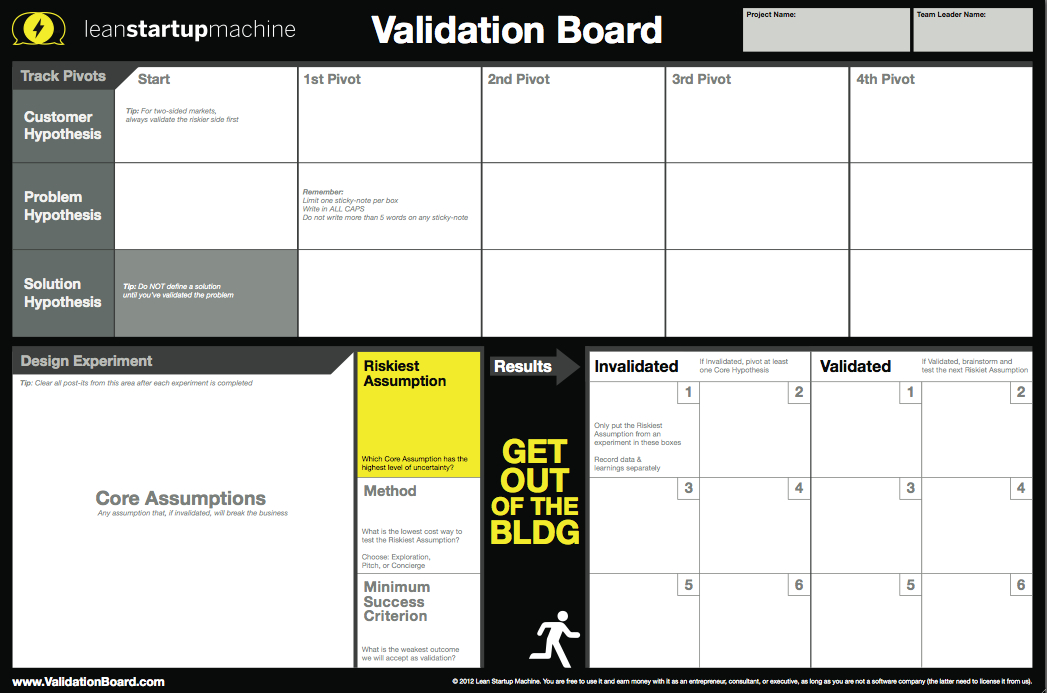
The entire process revolves around a validation board.  It looks like this:

You can download a copy of the validation board at www.leanstartupmachine.com and there’s a great tutorial on how to use it here.

It is deceptively simple.  You work with post-it notes, fat marker pens and a limit of 10 minutes per task and 5 words per post-it.

When The Mack described it to me, I was pretty dismissive.  My reaction involved a lot of eye rolling and “yeah, yeah, yeahs”.  And then I tried to apply it to a business idea I had.  I didn’t get out of box one.  I couldn’t define my customer or the problem that my idea was supposed to solve.  Like pretty much everyone, I’d started with a solution based on a whole load of untested assumptions.

Back to the validation board I went.  And this time I got The Mack to walk me through it:

Step 1 – Define your Hypotheses:  Who is your customer? (note, there could be more than one customer, e.g. if your idea has both a B2B and a B2C element to it: where you have a 2 or 3 sided customer group, you always validate the riskier side first).  What problem do you think that customer has?  Write these down (in max 5 words) and stick them on the board.

Step 2 – Define your Core Assumptions:  What assumptions are you making about the customer or their problem?  You need to get pretty basic with these – you are looking for assumptions that you’ve made in your mind that, if you’ve got them wrong, your business idea fails.  At this stage, all of your assumptions should be around whether or not the problem that you’ve identified actually exists for those customers.  If your initial assumptions are around things like “do they like my brand name?” or “is this the right pricing model?”, you’ve got ahead of yourself.  Write your core assumptions down (in max 5 words) and stick them on the board.

Step 3 – Identify the Riskiest Assumption:  So now you look at your 5 or 6 core assumptions that you’ve jotted down on the board.  You look for the single riskiest assumption. i.e., which is the assumption with the highest level of uncertainty?  This will normally be the key assumption on which your business idea hangs.  The reason for testing this one first is obvious.  If you’ve got this one wrong, then you’re dead in the water and all of the other assumptions are irrelevant.  Move this post-it note into the Riskiest Assumption box.

Step 4 – Decide how to Test that Assumption:  There are 3 methods for testing.

  • Exploration (interviewing target customers; making sure you ask open, not leading questions – and remember, you’re asking them about their “problem” not necessarily your perceived solution).
  • Pitching (getting customers to “buy” into your product via a dummy landing page, email sign-up, advert or similar).
  • Concierge (actually delivering your product to a small number of customers to find out what makes them happy so they’ll spread the word).

Clearly, they get progressively more time consuming and costly as you move from Exploration to Concierge, so you start with the cheapest and easiest route available to you.  Write down your method for testing your assumption in the Method box.

Step 5 – Define your Minimum Success Criteria:  This is pretty tricky.  For the assumption that you are testing, you need to decide what is the minimum threshold of validation.  Write down your minimum success criteria.  

The Mack said that a lot of the people at the workshop set their thresholds too high and wrote off their businesses as failures when they weren’t.  I would say that whatever threshold you set (for example, you develop a landing page for your product and you want at least 50 people to register their interest within 24 hours), if you don’t hit that threshold, take a moment to think about what that actually means.  It may not be total invalidation, you just may need to test again with slight tweaks to your method or you may have set your threshold artificially high.  However, don’t dismiss evidence of failure just because you’re desperate for your idea to be proved “right” – that defeats the entire purpose of this process.

Step 6 – Get out of the Building!!!:  This is where you stop thinking and start doing.  Execute your testing method (exploration, pitch, concierge).  This doesn’t have to take long – it can be a matter of hours or days.  Remember, the workshop is taught over a weekend.  The message they drill home is that it’s better to move quickly and do something than to spend hours overthinking it.  Get that feedback fast and make sure you’re talking to the right customer base.  For this purpose, friends and family do not count.  Do not include them in your results tally.

Depending on the outcome of your testing, when compared against your minimum success criteria, you will have validated or invalidated your assumption.  Move your post-it from “Riskiest Assumption” to either the “Invalidated” or “Validated” box.

Step 7 – Pivot or Test the Next Riskiest Assumption: If you’ve met your MSC, great.  Now identify your next riskiest assumption from the remaining post-its in your core assumptions box and go through the same process.  Do that until you’ve successfully validated all of your core assumptions.  All successfully validated? Now go make some money….

If your assumption was invalidated, don’t panic.  This is the whole purpose of the exercise, to identify obstacles to your product’s success.  Here’s where it gets interesting, so pay attention.  You now need to pivot.  And by Pivot, they mean more than just a minor tweak to your product.  A pivot refers to a real change to either your customer hypothesis (i.e. you were targeting the wrong customers) or to your problem hypothesis (i.e. the problem you identified doesn’t actually exist) or both (through your testing, you’ve identified a new problem for a different set of customers).  Write down your new pivot hypotheses under 1st Pivot.

And then you start the process again using these new pivoted hypotheses, so you go through steps 2 – 6 and see where you end up.  You may have validation or you may need to pivot again.  It really doesn’t matter.  What matters is that you move quickly through the process.  Assumptions are validated and you build on them or they are invalidated and you move on to the next.  And if ultimately your great idea proves not to be so great, well you’ll have saved yourself plenty of time, cash and heartache in finding out.

why this changes things for me

I’ve said before that I don’t consider myself a natural entrepreneur.  I get ideas, but most times I dismiss them.  Usually after having tried to think of every reason under the sun why they will fail.  I’ve found that my biggest stumbling block has been going from idea to any form of execution.  I’m using my own money for my business ventures and I’m hesitant to spend money when I don’t have a roadmap.

Which is why this lean startup process appeals to me.  I like having a method to my madness.  I particularly like having a visual method that is very practical, focused and has a rapid turnaround.  I’m a bit impatient.  I want to know quickly if an idea has legs.

I’m finding it a little slow-going to get to grips with it this first time, but following the steps has given me so much structure to my thought process and it’s actually made me enthusiastic again for some of my dormant ideas.  I’m heading to Launch48 this weekend, so I’m going to test it out on a bunch of strangers and see if the machine works.  And if it doesn’t, I’ll just pivot.

putting off procrasti-nation: part II

Part I in this series focused on the positives of procrastination as a way of allowing ideas to germinate in the headspace you create when doing very little.

Which is great, until I remember that just sitting around having ideas without acting on any of them is basically loafing. And it’s not helping my cash-flow.

But what to do? I am preternaturally disposed toward hibernation. Yes: in October. How then to motivate myself to get my arse in gear and start a business, when winter is practically upon us and I should probably concentrate on keeping warm..??

3 task challenge

Well, over dinner the other night, I casually mentioned to my gentleman friend* (as my great-aunt Lizza calls him) that there were a few things I wanted to get done this week for my business stuff. He shared a few of his own.  We decided it’d be a good idea for each of us to email the other with our top 3 tasks each Monday, with a deadline of Thursday to complete them or chase their progress.

If that sounds a little too 90s New Age self-help:

Bleurgghh.  Don’t worry.

This is gamification, baby.  You versus me.  Boy against girl.  Pure, raw, primal competition. Type A against Type A+ (me, natch). Grrrrrrrrrr. Bring it.

See. It works. You’re already feeling pumped up and ready to take on the world. Or at least to send that email you’ve been putting off for weeks.

Let me tell you, I got more done on that Monday than in the two weeks prior. And a Monday following a boozy, lost weekend, no less … unheard of.  And the gentleman friend*?  Well, last time I checked, he was consoling himself with his first loser podium place.  Better luck next time, punk.

So post your 3 tasks for this week on this blog. Then pick yourself a mutual motivator – it needs to be someone who will be merciless in their mockery if you bail – and set that weekly email.

You need to send your list of 3 tasks by 11am on a Monday and follow up with your buddy on Thursday.

Let the games begin!

* Ps.  I asked him what he’d like to be called for the purposes of this blog and he said “The Mack Daddy”.  Class.  Who am I to deny a man such a simple pleasure…?  So from now on, “The Mack” it shall be.

I refused to add a photo of Mark Morrison.

For those of you unaware what “Mack Daddy” means, here’s a helpful definition:

© MerriamWebster

the art of esc-apology

3 signs that you’re ready to escape your city job:

  1. your anxiety dreams always involve a lot of corridors, large rodents and only being able to run backwards in slo-mo
  2. you quiz the servers in Starbucks or Waitrose on their hours, pay and general job satisfaction
  3. your pee is hazchem yellow, courtesy of Berocca, but you’re still ill every time you take holiday

I knew I wanted out pretty much from the in.  Sure, I was seduced by the free Monday night bar, the mid-week softball games and power dressing.  But that stuff wears off.

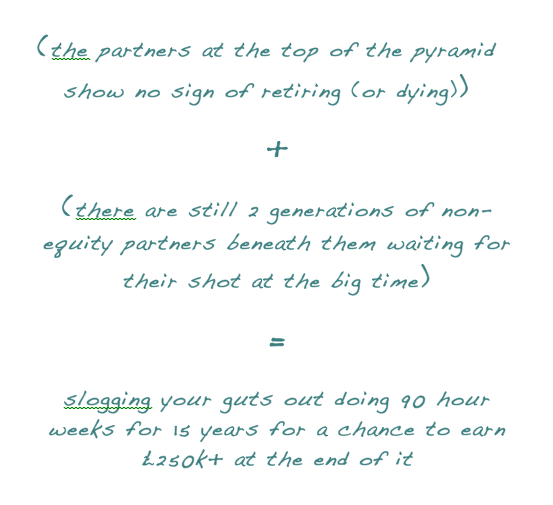
Maths was one of my strong subjects and it didn’t take me long to figure out that:

Then you realise:

Are they hiring us for our brains or gullibility?  But don’t worry, it all makes sense because of the career satisfaction and the quality work and the job security.  Oh wait……

my escape route  

Ok, so I’m still feeling my way through this business lark and I can’t claim any financial success yet (give me a break, it’s only been 2 months and I spent most of that time partying in Ibiza and watching the Olympics…).

But here’s how I did it and some tips if you want to come join this brave new world.

  • Big firm pedigree:  I started my career at a big, prestigious firm.  That tells people that I must be incredibly smart, well trained in my specialism and know how to be professional.  Which helps my credibility nowadays when I turn up for client meetings in denim shorts and floral trainers.
  • Small firm experience: I never ultimately wanted to work for major banks or corporates.  My target client base was fashion designers and other creatives.  So I downsized after 3 years to a firm with these types of clients.  The benefits: massively increased client contact and autonomy and no real salary drop once you factor in tax.
  • Industry expertise: I wanted to be in business, but not in the business of providing legal services to lots of clients.  So I stepped sideways with a twist.  I went to work for a fashion comms agency in a hybrid legal/commercial role.
    • I set up a new company division doing licensing deals for fashion designers/celebs using the commercial experience (deal structure, royalty rates etc.) gained from doing exactly that whilst in my small firm; and
    • I was global legal counsel for the company, which meant that I was intimately involved with the running of the business and helped the founders with their decision-making.  That meant I got to practise business skills with someone else’s money and reputation.
  • Financial independence: I saved some money to cash-flow me for a set period of time without a salary whilst I’m starting up my business.  Let’s face it, when you’re working all hours, you don’t have time to spend it, so that bit should be relatively easy.  If it’s not, then you need to take a good, hard look at your ridiculously frivolous lifestyle and trim the fat.  Gents, ditch the gadget addiction.  Ladies, stop kidding yourselves that shopping is a legitimate hobby.
  • Safety in numbers: Before I quit, I spoke to loads of people who don’t have a conventional office-based working life, to find out how they cope.  Weirdly, practically all the new people I’ve met since I decided to escape the slog are part-timers, freelancers, semi-retired, remote-workers and business jugglers.  The fact that none of them are living on the bread line and all seem to be enjoying quite a nice lifestyle, thank you very much, encouraged me to join their ranks.

There are lots of resources/communities online for non-traditional working lifestyles.  Check out Escape the City for information and inspiration.

  • Tell everyone: There’s nothing like announcing your plan to quit to actually force you to do it.  So tell your friends, your family, your colleagues, your bosses (that last one kinda counts as no going back).  I gave my employers 6 months’ notice.  It gave them time to figure out how to replace me.  It gave me time to get used to the idea of not working and to plan for it.  It meant that I left on great terms with everyone and with a lot of people wanting me to succeed and who can possibly help me in my business down the line.

And that was it.  I left my job with nothing to move on to.  It felt like the right time for me to do my own thing and give freedom a whirl.

And in the words of Dumb and Dumber: “I like it. I like it a lot.”

hello hello

Hello and welcome to my blog all about quitting my job and starting up my own business.

First blog posts are a bit strange.  You know that no-one except your mum and a few of your mates are going to read them.  So you feel a bit silly and self-indulgent writing great swathes of advice and anecdotes.  But that doesn’t stop you putting in hours of effort, just in case anyone else stumbles across your posts. 

Then you have that anxious anticipation, wondering how many followers you’ll get (and persuading your mum and mates to sign up from various random email addresses to boost your numbers…. ahem).

so why am I making myself do this..?

Mainly, to give me something to do whilst everyone else out there is making an honest living.

But also because even though I’ve been quite successful in my career, I always admired people who started up their own thing.  And even though I’ve helped run and shape businesses, I’ve still always had the sense that “starting a business” is this mystical thing that only natural born entrepreneurs can do.

I don’t feel like an entrepreneur.  I definitely don’t look like an entrepreneur.  Hmmmm, maybe I’m not cut out to be an entrepreneur….

how hard can it be?

I think that a lot of us (me included) are scared off by this idea that in order to be successful in business, you have to be this dynamic, well-connected, wheeler-dealer with big, game-changing ideas and ready-made speech bubbles of marketing spiel coming out of your mouth.

But then you look around and realise just how many people are starting and running their own businesses.  Your hairdresser, the local shopkeepers, your friend who does freelance graphic design.  And none of them look like Richard Branson.

So I’ve decided to write this blog to give myself a focus for starting up my own thing.  To jot down tips and advice that I find along the way and share that with you, my 3 loyal readers (thanks guys!).

I’m not a natural entrepreneur, but I am a natural encourager and if I can encourage just a couple of people to have a go at doing something for themselves, then it’ll all be worthwhile.

I would love to get feedback on posts (please play nicely!).  Also, if there are topics you’d like to know about, then shout and I’ll do my best to cover them.

Thanks for reading and hope to see you again soon.

Caroline x