putting off procrasti-nation: part II

Part I in this series focused on the positives of procrastination as a way of allowing ideas to germinate in the headspace you create when doing very little.

Which is great, until I remember that just sitting around having ideas without acting on any of them is basically loafing. And it’s not helping my cash-flow.

But what to do? I am preternaturally disposed toward hibernation. Yes: in October. How then to motivate myself to get my arse in gear and start a business, when winter is practically upon us and I should probably concentrate on keeping warm..??

3 task challenge

Well, over dinner the other night, I casually mentioned to my gentleman friend* (as my great-aunt Lizza calls him) that there were a few things I wanted to get done this week for my business stuff. He shared a few of his own.  We decided it’d be a good idea for each of us to email the other with our top 3 tasks each Monday, with a deadline of Thursday to complete them or chase their progress.

If that sounds a little too 90s New Age self-help:

Bleurgghh.  Don’t worry.

This is gamification, baby.  You versus me.  Boy against girl.  Pure, raw, primal competition. Type A against Type A+ (me, natch). Grrrrrrrrrr. Bring it.

See. It works. You’re already feeling pumped up and ready to take on the world. Or at least to send that email you’ve been putting off for weeks.

Let me tell you, I got more done on that Monday than in the two weeks prior. And a Monday following a boozy, lost weekend, no less … unheard of.  And the gentleman friend*?  Well, last time I checked, he was consoling himself with his first loser podium place.  Better luck next time, punk.

So post your 3 tasks for this week on this blog. Then pick yourself a mutual motivator – it needs to be someone who will be merciless in their mockery if you bail – and set that weekly email.

You need to send your list of 3 tasks by 11am on a Monday and follow up with your buddy on Thursday.

Let the games begin!

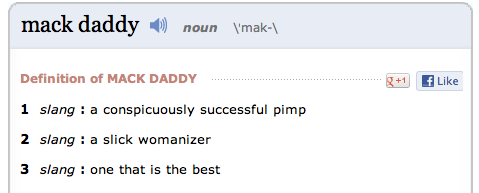
* Ps.  I asked him what he’d like to be called for the purposes of this blog and he said “The Mack Daddy”.  Class.  Who am I to deny a man such a simple pleasure…?  So from now on, “The Mack” it shall be.

I refused to add a photo of Mark Morrison.

For those of you unaware what “Mack Daddy” means, here’s a helpful definition:

© MerriamWebster

time rich cash poor … where to find fun on the cheap

Now that they’ve got over the fact that I no longer work for a living, my friends have started to express concern for how I manage to fill my time.  I think they have visions of me sitting blank-eyed and wild haired, alone on my sofa at home all day, just waiting for everyone else to finish work so I have someone to play with.

Look away now if you don’t want to hear this, but there is a whole world of stuff you could be doing, if only you had the time to do it.  And the best part, loads of it is free or under a tenner, so even us salary-dodgers can get involved.  You just need to know where to look…

Here’s my roundup of where to find free fun (as opposed to fun free: I’ll pass on that, thanks all the same) and general goings-on in London:

© 2012 Londonist

Londonist:  has a permanent “Free London” section on its site and also does a weekly roundup of all things cheap and cheerful.  Usually my first stop when looking for something to do, as it has a really eclectic mix of listings, from exhibitions and talks, to festivals and geekery.  I love the fact that it doesn’t just cover the well-known events, but lots of smaller, local happenings too and it’s well-edited, so you don’t have to search for what’s on.

Look out for:  the “Things to do in London this Weekend” section, published each Thursday and the “Week in Geek” section, for curious types.

© le cool 2012

le cool Londonsign up for their weekly email (every Thurs) to get your cool fix.  Their recommendations are usually on the quirkier side of average and it’s set out as a day-by-day guide: le monday, le tuesday (you get the idea).

Look out for: their guides to other European cities (Barcelona, Paris, Istanbul etc.) and their blog, to read about what you’ve missed out on doing!

© 2012 Thrillist

Thrillist London:  sign up for their daily email or check out their website, where you can search under categories.  Best for new restaurant and bar openings, although they do also feature some unusual events (zombie evacuation race, anyone?).  If you love pop-ups, this is your guide.

Look out for: their same-format US city guides.  London is the only non-US city featured (lucky us!), so if you’re travelling stateside and want to find the coolest hangouts, check them out.

© 2012 Scout London

Scout London:  a newish listings magazine and website.  Covers all of the categories you’d expect: art & culture, comedy, film, food & drink, music, sport etc.  The editorial is a little lacking, but think of it as a less cluttered Time Out and you won’t go far wrong.

Look out fortheir free weekly magazine available from selected London tube stations every Tuesday.

© 2012 Time Out Group Ltd

Time Out: deserves an honourable mention, particularly now that the magazine is free (available from selected zone 1 – 2 tube stations and museums/galleries) and is an edited version of the old style magazine, so much easier to find what you’re looking for.  They have critics’ choices and detailed reviews and they highlight those events that are free.  My only criticism is that the listings are so comprehensive that sometimes you lose the will to live sifting through to find the good stuff.

Look out for: their ipad and mobile apps, when you’re on the move and need a recommendation, fast.  

Lastly, if you can’t quite let go of some of your lavish habits (spa days, cocktails, fancy dinners), make the most of the ever-increasing spamathon of voucher deals (livingsocial, groupon, amazonlocal, wowcher, wahanda).  Being able to do things during the day gives you many more options for fun.  And it feels way more decadent.

Go wild.

Oh, and if anyone has any other suggestions for where to find cool stuff, please share in the comments section.  Thanking you.

putting off procrasti-nation: part I

I don’t know about you, but I’m pretty certain that if I were even half as good at any one thing as I am at putting off doing stuff, then I would probably own half of Europe by now (the half that’s still worth something).

Instead, it’s taken me nearly two weeks to write this post.  And I’m still in the motivated “honeymoon” phase of blogging.  I’m doomed.

I know folk who always do what they say they’re going to do.  Who take themselves off quietly to apply themselves to the task and deliver it in good time with no drama or histrionics.  Come on guys, cut it out.  You’re giving the rest of us a really bad rep.  I honestly don’t know how you can sleep at night.

Me? I’m grateful if my procrastination takes any vaguely constructive form.  If I get as far as cleaning the bathroom or having some food in the house, I’m mentally high-fiving.  My own brand of procrastination usually involves a 4Music 50-most-identikit-songs marathon.  But, man, have I learned to bust some moves….  If anyone out there needs an expert in sitting-down pop video dancing.  Call me.  I am ready.

If someone could please teach me how to stop procrastinating, I will pay good money (and, if you’re thinking of this as a business idea, you’re also going to need to get me to sign up for the course, attend the lessons, do my homework and apply it in my daily life…).  Derren Brown, are you listening?  I’m relying on you, man.  You’re the only one who can save me now.

productive procrastination

There is another school of thought.  That says that in those moments when you do something trivial or nothing at all; when you stop forcing yourself to think, or focus, or try so damn hard, you give your brain the space to be creative and that’s when the ideas will come to you.

 “It takes a lot of time to be a genius. You have to sit around so much, doing nothing, really doing nothing.” 

― Gertrude Stein

My clever mum bought me an incredible book before I quit my job.  It’s written by an amazing woman called Brenda Ueland and it’s called If You Want to Write: a Book about Art, Independence and Spirit.    It was first published in 1938, but you wouldn’t know it.  Ueland’s advice and philosophy are timeless.  The basic premise is that we all have creative ideas and ability.  But we stifle creativity by wanting it to generate success or financial reward.

enjoy the process

I was a lawyer for a long time.  Creativity is not wildly encouraged in the legal profession.  I came out with my creative-confidence severely dented.  I really had no idea how to generate business ideas.  Then I read Ueland’s book.  And I realised that the key is not to judge your productivity or your output.  The key is just to have a go and to enjoy the process of creating.

That’s what I’m doing here.  Watching reruns of Fresh Prince and eating frozen food.  And I have to tell you that the ideas have started to come a little easier.  And I’m not judging them.  I’m just writing them down… and I’m enjoying myself in the process.

i ♥ london

Dear London

Just a little note to say that you looked beautiful last Saturday and I had such a lovely time with you.  Thanks so much for opening your doors to us, it was a really good weekend.  I’ve included some pictures of our day together.  The weather was amazing!

I know sometimes I get a little grinchy with you, when you’re too busy, but you know I don’t mean it really.  I still think you’re the coolest thing on earth.

See you soon,

Caz xxx

* For those of you who’ve never done Open House London.  You must!  It’s on every September (next year’s dates are 21 and 22 Sept 2013).  I’ve done it on and off for about 15 years.  There’s an amazing mix of historical and architecturally significant buildings and private residences that open their doors to the public for the weekend.  It’s totally free.  This year I even got to do a tour of the Beefeater Gin Distillery, tucked away in Kennington!

mo’ money, mo’ problems

The dreadful thing about having a steady job and a decent monthly salary is that you become conditioned to believe that you need it.  And if you don’t particularly enjoy your job, then that salary becomes the justification for sticking it out and the means of paying for all those treats you buy yourself to make up for it.  Sound familiar??

Allegedly, there’s a button on Word Press that allows you to insert a poll.  I am nowhere near that level of technical wizardry, but if I were to do a poll of top reasons for not starting something new, I’d guess that lack of cash/fear of financial meltdown would come up pretty high.  Understandable, perhaps, but (whispers), I think you might be using this as an excuse…

what’s it worth?

I’m not going to pretend that it’s easy to walk away from a salary.  It’s not.  I thought long and hard about when to do it.  I gave 3 months’ extra notice on my job, just to get that bit more cash in the bank and to give myself time to adjust to thinking about my finances differently.

But ultimately, I decided that I valued my time more than I valued the money I was earning.  Ask me again in 12 months’ time, but right now I wouldn’t go back to employment for all the tea in China.

easy for you to say

I hear you.  It’s easy for me to enthuse about lifestyle changes when I’m childless, mortgage-less, debt-free and have no dependents relying on me.  That’s all true.  But I still have financial obligations.  I pay a staggering amount of monthly rent and council tax on my flat (London, I love you dearly, but you’re killing me).  I don’t have a pension, stocks or shares or any other security, except the cash in my bank and my earning potential.

I’m not here to tell you that my way is the best way.  That everyone should quit their jobs, eschew material things and live like financial nomads in pursuit of spiritual enlightenment.

It’s just that I’ve realised that this is the best way for me, right now.  And maybe it’s something you’ve wondered about.  In which case, use what I’ve learned so far to see what your options are.

you do the math*

I’m a little scared of money.  I didn’t have a lot growing up, so I’m probably more fearful than most about not having enough.  In my last job, I did a lot of forecasting and financial modelling for investment raising and I learned to read a balance sheet, P&L and cash-flow statement.  So when I was trying to decide if I could afford to leave my job, I applied that learning to my own finances.

Personal balance sheet

Crucial first step: you need to work out what you’ve got in terms of assets and liabilities.

If you’re a whizz on excel, then start using a spreadsheet for your personal finances.  It does all the number crunching for you, so you’re less likely to make mistakes.  Otherwise, just write it out old-school in a notebook.

You need two columns: Assets and Liabilities.

Under the “Assets” column, list out all your assets (the value of your house/flat/car, cash in the bank, stocks and shares, pension, ISAs, premium bonds, etc.).

Under the “Liabilities” column, list out all your liabilities (your current total mortgage owing, credit card debts, car repayments, etc.).

Deducting the total amount of Liabilities from the total amount of Assets, gives you your basic net worth in money terms.  It will either be a positive number (i.e. what you own is greater than what you owe) or negative (i.e. what you owe is greater than what you own).

Remember, it’s a snapshot of this moment in time and will change, but it gives you a good indication as to whether you have assets you can free up to finance your lifestyle change.  Don’t panic if the picture looks bleak.  A negative personal balance sheet doesn’t mean you’re stuck as a wage slave forever.  It’s only part of the equation.
Cash-flow

Next, you need to work out your average monthly cash-flow, so you know what you need to earn to meet your commitments.  For this you need 3 columns: a blank first column, then “Monthly Income” and “Monthly Expenditure”.

In your first column, list out each category of income and each category of expenditure, as this allows you to do a more detailed projection.  Then deduct the total expenditure from the total income, to get your balance.

It should look something like this:
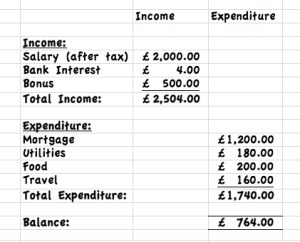
Do this exercise for at least 3 months back (go through your bank statements to work out each month’s expenditure).  This will help you to then get an average of your monthly income and outgoings.  This is essential before you even begin to consider giving up your salary.

You need to know that your assets (from Step 1 above) and your non-salary income are sufficient to meet your expenditure requirements going forward.

Remember: not all assets are created equal.  Cash is king, because you can get at it readily.  Having a house that’s worth a lot of money does not help with cash-flow, because it will take time to remortgage it or sell it to get cash in your hand.

what’s the plan, Stan?  

It pains me to tell you, guys, but quitting your job and going solo does require a bit of planning.  There’s nothing that sours the satisfaction of giving the 2-fingered salute to full-time employment like having no way to pay your rent next month.

So don’t rush it.  It’s rarely so bad that you can’t stick it out a couple more months.

You’ve got your balance sheet and cash-flow data, so use it to forecast your new life.

1.     Improve your cash-flow (or stop spending so much goddam money on stuff you don’t need)

  • I’m not a massive consumer (unless you count booze, in which case I’m right up there with the best of them).  I’m also pretty thrifty.  I have spidey sense to spot the “reduced to clear” stickers in the supermarket.  I rarely shop for clothes and, when I do, I sell a load of my back-wardrobe on eBay (seller name raghi77 if you’re interested…).  Before you buy anything, ask yourself if it will help or hinder your new lifestyle.
  • I spend my money on experiences – travel, festivals, gigs, nights out with friends, spa sessions.  These don’t come cheaply, but they do tend to come less frequently, so it helps with cash-flow.  I also tend to pay for these on a cheap credit card (look for 0% balance transfers and purchase deals on moneysupermarket.com), so I have longer to pay them off.
  • If you can start up your business by working on it during weekends/evenings around your existing job, then for gawd’s sake do that.  Keep the money rolling in from your salary to finance it, so that the financial risk is lower.
  • Consider going part-time or freelance for your existing company.  You may feel like you couldn’t stand to work another day, but you’d be surprised how differently you feel once you’re in control of your time.
  • Before you quit, sign up with some temp agencies for your specialism.  Knowing that you can get a few weeks’/months’ work here and there as you need it helps to keep the fear gremlins at bay.
  • Separate your bank accounts.  Put the majority of your savings beyond easy reach somewhere where it’s earning a reasonable rate of interest.  Set up a standing order to feed your monthly cash requirement into your day-to-day account and have a second current account with a buffer amount in it, for contingencies.  Then learn to live within your means (easier said than done!!).

2.     Weave your safety net

Ask yourself what you could realistically do to get money in if you were in a tight spot or to finance your new business plans.  For most people, this will mean looking at your assets on your balance sheet and working out how to make some money out of them. For example, you could:

  • rent out / sell / remortgage your house
  • cash in stock options / ISAs / pensions
  • borrow money
  • sell other assets (car, clothes, furniture)

Clearly these are big decisions and should not be taken lightly unless you derive perverse pleasure from riding a financial rollercoaster.  But what I’m trying to get across is that most people have options when it comes to money.  These options may seem terrifying and some may be totally inappropriate for your circumstances, but they should all be factored in to your financial planning.

Knowing that you have a safety net (or starting to weave one) allows you to shift your focus away from simply surviving to creating your new life.

I am fortunate that I have a reasonable amount of money saved up to support me.  But I’ve also downsized my living arrangements, cashed in my Oyster card (getting around by bike also keeps me fit), stopped getting my hair cut so frequently and haven’t been into a clothes shop in 6 months.

I’m still working on cutting down on my £10-a-pop cocktail habit…..

 *sorry for the Americanism, but it scans better…

curiosity kills the boredom

“The cure for boredom is curiosity.  There is no cure for curiosity.”  — Dorothy Parker

I don’t fear anything so much as boredom.  My primary school headmaster told me, “only boring people are bored”.  Uh-oh.  Maybe that’s where the fear set in.  And the need to spike everything with a little mania and adrenaline.

Other people don’t know that I’m bored.  No reason why they should.  I don’t have B.O.R.E.D. tattooed across my knuckles.  Over the years they’ve mistaken it for apathy, perfectionism, bravado, showing off and ambition.  None of the above, guys, just trying to outrun the boredom.

When I want to sound smart or deter questions, I’ll say that my boredom is born of existentialism.  Dress it up as a philosophical state.  Cabin fever of the soul.  I am, therefore I’m bored.  Discuss.

curiosity

Curiosity is the antidote.  Or at least the homeopathic rescue remedy.  It may not cure you, but it will stave off the worst of the jitters.  And the best part is you can self-medicate.

Some people have a wise kind of curiosity.  Theirs comes from experience and knowledge and tolerance and acceptance.

Others have a driving, passionate curiosity.  They want to understand everything and to use that to create.  Thomas Heatherwick is one.  Everything about his work speaks of curiosity and an inquisitive mind.  At the Heatherwick Studio exhibition at the V&A, everything that he and his team have created, from the rolling bridge at Paddington, to the Olympic cauldron, and the Spun chair, made perfect sense to me.  I walked around the exhibits, thinking to myself, “of course, that’s exactly how it should be.  How wonderful, what a clever man”.

Heatherwick Studio, Rolling Bridge, Paddington

bored, sir, but never boring 

I don’t have that quiet, thoughtful curiosity.  Nor that instinctive ability to interpret and improve.  Mine has pretty much remained at the 5 year old development level.  It’s less spiritual temperance or creative genius; more unchecked over-excitement and shiny-eyed wonder.

My head is permanently slightly tilted in meerkat fashion, anticipating some new excitement.  Apparently I bob along, rather than walk, looking up and around, just in case I miss something interesting.  I’ll still make a beeline for a bouncy castle (especially if it’s got a slide) – I suspect Jeremy Deller is the same, if his Sacrilege inflatable Stonehenge installation is anything to go by.  My favourite words of encouragement are “c’mon, let’s just see….”.

I question and explore and marvel and drink in and force the boredom to chase after me.

And the pleasure to be gleaned from a little curiosity spent is an incredible return.  I use my curiosity (and my fear of boredom) to spark ideas and to keep me interested and interesting.

Now to harness that curiosity for learning and business creation ……. maybe there’s a niche in bouncy castles for grown-ups….?

olympic fever

I went Olympics and Paralympics-tastic this summer.  It was no coincidence that I gave up work just before London 2012 started!  My daytime freedom meant that I was everyone’s chosen +1 to events.

my sis and I flying the flag for Team GB

I went to the beach-volleyball, football, weight-lifting, athletics, road cycling, triathlon, wheelchair basketball and hand-cycling and I watched the TV coverage all day every day and all of the round-up programmes at night.

I whooped and held my breath and cried several times a day.  And I was inspired.  Massively inspired by the athletes, their sacrifices and their commitment, all for a shot at glory four years in the making.

Don’t get me wrong.  I think they’re all bonkers, but there is something in that unrelenting pursuit of goals that struck me as a universal truth.

keep clear goals, track progress

Keeping your goals clear and tracking your progress is, according to all the gurus on success (be it measured in weight loss, wealth, sporting prowess, political influence, pairs of Alaïa shoes), the surest way to achieve those goals.

Some people shy away from setting goals, especially if their dreams are financially motivated.  If your goal is to make loads of money, then go for it. There’s no crime in making money. Unless you’re making the money from crime. In which case this leads to an awkward moral dilemma and makes me question if I even want you reading my blog.

my goals

My goals right now are below.  In my own to-do list, I use these goals as a header and list out the steps I need to take to achieve each one (see first example below), with a deadline.  I find this helps my focus, which otherwise tends to wander.

Note that one of my goals is a “pleasure” goal.  To me, the whole point of this lifestyle change is to enjoy experiences.  I don’t use these pleasure goals as a reward for doing the business stuff.  Instead I just try to build them into my life, so I get the balance right between focused activity and focused inactivity.

1.   Set up the first simple online business that’s still at ideas stage now, before India trip in November.

  • interview web developers – by 30 September 2012
  • compile brief for site functionality and look and feel – by 14 October 2012
  • test projected site traction and SEO – by 21 October 2012

2.   Relax on the beaches of Goa and the backwaters of Kerala.

  • bit of yoga
  • pakora o’clock, followed by fresh tandoori red snapper and the best Bombay potato known to man

3.   Earn enough from the first business in the 6 months from launch to finance next business idea.

accountability

I’ve chosen to blog about my progress, as a way to keep me on course. Other people prefer to use personal finance markers or task completion milestones that they’ve set for themselves. Personally, I need the accountability that comes with making a very public commitment.

If an idea dies in a forest but there’s no-one around to see it, etc., etc.

You get my drift. Tell a handful of people who you respect what your goals are. And be as specific as you can. Trust me, it’ll make it much easier to keep them, when they’re not just your dirty little secret.

Alternatively, you can post them here in the comments section, if you want to, and I’ll do a little cheerleading for you.  Just please don’t post anything that you need to keep secret.  Or that is moronic.  I have a reputation to maintain, after all.

Team GB, Team GB, Team GB, Team GB!!!!!!

the art of esc-apology

3 signs that you’re ready to escape your city job:

  1. your anxiety dreams always involve a lot of corridors, large rodents and only being able to run backwards in slo-mo
  2. you quiz the servers in Starbucks or Waitrose on their hours, pay and general job satisfaction
  3. your pee is hazchem yellow, courtesy of Berocca, but you’re still ill every time you take holiday

I knew I wanted out pretty much from the in.  Sure, I was seduced by the free Monday night bar, the mid-week softball games and power dressing.  But that stuff wears off.

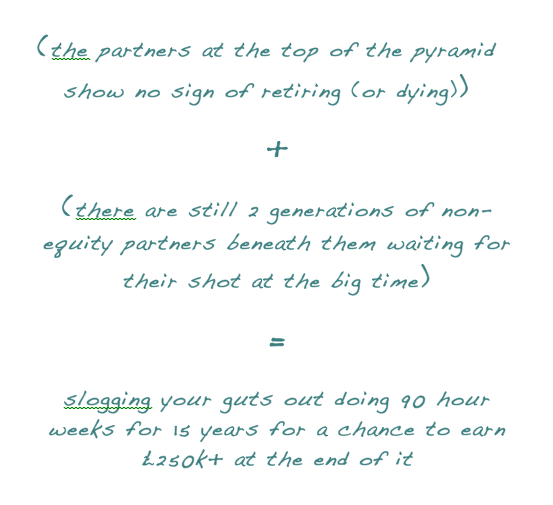
Maths was one of my strong subjects and it didn’t take me long to figure out that:

Then you realise:

Are they hiring us for our brains or gullibility?  But don’t worry, it all makes sense because of the career satisfaction and the quality work and the job security.  Oh wait……

my escape route  

Ok, so I’m still feeling my way through this business lark and I can’t claim any financial success yet (give me a break, it’s only been 2 months and I spent most of that time partying in Ibiza and watching the Olympics…).

But here’s how I did it and some tips if you want to come join this brave new world.

  • Big firm pedigree:  I started my career at a big, prestigious firm.  That tells people that I must be incredibly smart, well trained in my specialism and know how to be professional.  Which helps my credibility nowadays when I turn up for client meetings in denim shorts and floral trainers.
  • Small firm experience: I never ultimately wanted to work for major banks or corporates.  My target client base was fashion designers and other creatives.  So I downsized after 3 years to a firm with these types of clients.  The benefits: massively increased client contact and autonomy and no real salary drop once you factor in tax.
  • Industry expertise: I wanted to be in business, but not in the business of providing legal services to lots of clients.  So I stepped sideways with a twist.  I went to work for a fashion comms agency in a hybrid legal/commercial role.
    • I set up a new company division doing licensing deals for fashion designers/celebs using the commercial experience (deal structure, royalty rates etc.) gained from doing exactly that whilst in my small firm; and
    • I was global legal counsel for the company, which meant that I was intimately involved with the running of the business and helped the founders with their decision-making.  That meant I got to practise business skills with someone else’s money and reputation.
  • Financial independence: I saved some money to cash-flow me for a set period of time without a salary whilst I’m starting up my business.  Let’s face it, when you’re working all hours, you don’t have time to spend it, so that bit should be relatively easy.  If it’s not, then you need to take a good, hard look at your ridiculously frivolous lifestyle and trim the fat.  Gents, ditch the gadget addiction.  Ladies, stop kidding yourselves that shopping is a legitimate hobby.
  • Safety in numbers: Before I quit, I spoke to loads of people who don’t have a conventional office-based working life, to find out how they cope.  Weirdly, practically all the new people I’ve met since I decided to escape the slog are part-timers, freelancers, semi-retired, remote-workers and business jugglers.  The fact that none of them are living on the bread line and all seem to be enjoying quite a nice lifestyle, thank you very much, encouraged me to join their ranks.

There are lots of resources/communities online for non-traditional working lifestyles.  Check out Escape the City for information and inspiration.

  • Tell everyone: There’s nothing like announcing your plan to quit to actually force you to do it.  So tell your friends, your family, your colleagues, your bosses (that last one kinda counts as no going back).  I gave my employers 6 months’ notice.  It gave them time to figure out how to replace me.  It gave me time to get used to the idea of not working and to plan for it.  It meant that I left on great terms with everyone and with a lot of people wanting me to succeed and who can possibly help me in my business down the line.

And that was it.  I left my job with nothing to move on to.  It felt like the right time for me to do my own thing and give freedom a whirl.

And in the words of Dumb and Dumber: “I like it. I like it a lot.”