crowdfunding – money for nothing?

In the olden days, if you wanted to start up a business or launch a new product, you either had to have lots of your own money or find an investor willing to part with theirs.  For most budding entrepreneurs, it meant having a whip-round amongst friends and family to raise seed capital.  Which, inevitably, meant that those same friends and family then felt that they had acquired the right to tell you exactly where you were going wrong with your idea…

Then came Dragons Den.  Which taught us all that the boy scout motto applies equally to investment pitches and convinced the entire nation that an idea without a patent is utterly worthless.  It also provided a valuable insight into human beings’ capacity for self-deception (remember the guy who wanted £100k for his amazing device for helping drivers drive safely abroad??  It turned out to be a single glove that you wear on your right hand when travelling abroad, to remind you which side of the road you should be on…).

All very enlightening, but, ultimately, it was hard to take the show seriously when one of the dragons clearly thought that a retail high street stationery business was a good idea.

I’m out.

crowdfunding

Now there’s a new way to get investment.  It’s very trendy and inclusive and gives people a warm, fuzzy feeling inside.

It’s called crowdfunding and it involves getting lots of people to invest a small amount of money in your business or product.

When I first heard about it, I was skeptical. I mistakenly thought that each person who invested would get a teensy piece of equity in the business, so you’d have lots of little shareholders.  I assumed that it was a bit like taking your company public, but without people being able to then buy and sell their shares.  I thought that it sounded interesting, but I wondered what would happen if you wanted to sell your company on?… hmmm.

Turns out I was right to be skeptical, but way off the mark in terms of how crowdfunding works…

kickstarter

There are a ton of crowdfunding platforms out there now, but Kickstarter is the biggest for the US and UK markets.  The Mack was looking to use it for one of his business projects and explained how it worked.  We were in a Vietnamese restaurant at the time.  I almost spat my pho out at him.  I definitely remember telling him that he was immoral and that I wouldn’t be any part of it.

Overreaction?  Maybe a tad, but I’ll let you be the judge of that.

So the premise of crowdfunding is that it allows individuals to invest small amounts in businesses or projects that they like the look of and it allows companies to raise money without having to give away any equity.  Typically, individuals can invest upwards of $5 in a project.  In return, they get some sort of reward or recognition.  Whether that’s a name-check on the art film project or an advance copy of the role-play game they’ve invested in.

So you could look at it as a platform which gives rein to the ultimate free market principles.  Power to the people.  A chance for consumers to influence the latest products and support the arts.  A way for small companies to forward-sell innovative products.

Or, like me, you could just look at it as absolutely barmy and ripe for scamming.

money for nothing?

Because it’s not even money for old rope.  It’s basically free money.  It’s the equivalent of the friends and family whip-round of old, but with 10 million mates all chipping in a couple of quid.

It flies in the face of all conventional business wisdom on bootstrapping and angel investment and careful financial husbandry.  You don’t need a business plan.  You don’t even need a company.  You don’t need to show anyone your finances.  Or tell investors how you plan to spend the money they’re investing.

All you need is a project, a snazzy marketing video and enough people who are happy to part with the cost of a latte, and bingo!  Instant success.

Because not only do you raise the money that you need, but you also get massive exposure to your target audience and, if your fundraising exceeds all expectations (the largest amount raised was $10m; over 10,000% of the target), the media will pick up on it too, so further free advertising and even more potential customers.

The most successful projects seem to be those involving funky technology products (smart watches, games consoles), computer games or arty stuff.  That would seem logical – the people who like those things tend to be early adopters anyway, so of course they’d jump at an opportunity to say that they helped make that product a reality.

The Mack and I think it’s only a matter of time before crowdfunding is taken over by organised crime.  Gullible punters willing to part with cash in return for nothing?  It’s the ultimate investor-endorsed Ponzi scheme.

Maybe because of this, Kickstarter has closed its platform to all but “creative” projects.  Don’t be put off.  It seems as though “creative” stretches a long way.  Just take a look at some of the projects that have been funded recently and you’ll get an idea of what flies and if it could work for your project.

And even if Kickstarter is a non-starter, there are many more crowdfunding platforms out there.  Country-specific platforms, sector-specific platforms, even worthy causes platforms.  If you’re looking to attract crowdfunding, then you need to think seriously about the amount of money you need to raise and which platforms get enough of the right eyeballs to make that likely.  As with all of these things, with popularity comes fragmentation and if there are too many platforms, then it becomes harder to attract enough mugs, sorry, investors, to your project.

So my advice…  Get in there now if you’ve got an idea but no cash.  In a troubled economy, it seems there is no shortage of people willing to throw money at new “stuff”.  And they expect almost nothing in return.

Jeez, I bet Madoff wishes he’d thought of this…

highs and lows of semi-retirement

There are two distinct parts to being semi-retired.

There’s the incredibly smug “retired” bit, where you spend your weekdays flaunting your freedom.  Being able to see sold-out exhibitions, going for a slap-up afternoon tea just because you fancy eating miniature food, or starting cocktail o’clock at 3pm on a Tuesday… It doesn’t really matter what you do – all that matters is (1) you’re not at work and (2) you make sure everyone knows it.  You know you’re doing great at this bit when your nearest and dearest regularly tell you via facebook to stop showing off and get a bloody job.

afternoon tea

And then there’s the less smug “semi” bit.  Which basically translates as not having enough money to actually retire.  And then translates as having to email all your mates and former colleagues and random people you once met at a work “do”, to ask them if they have any work that they need help with.  And finally translates as ringing round various temp agencies to tell them that you pack a mean 70-words-per-minute and surely somebody, somewhere needs a jaded former lawyer with an acute allergy to hard work??

reality check

Six months into the new lifestyle and time to take stock.  For anyone watching my progress with (a) a view to jacking it in and living the dream, or (b) anticipatory schadenfreude, here’s a list of the highs and lows so far, to help you make your mind up.

the highs

  • leaving my job and being able to leave all the accumulated stress and mental energy behind.  I expected there to be a time-lag between physically quitting and mentally quitting.  As it turned out, I seemed to shrug it off as I walked out the door.  See ya, suckers!
  • how incredibly supportive and enthusiastic everyone has been.  And also how my decision seems to have positively rubbed off on other people, even without my doing anything.  I don’t think that I’ve made it look particularly easy, but I think I have shown that there is an alternative to what we’ve been sold.
  • being able to go full olympics last summer and being massively over-excited every day for the best part of a couple of months.  Typically whilst wearing ridiculous union-jack-emblazoned outfits.
  • learning new stuff and meeting new people.  So far, I’ve learned basic html, javascript and css (all very poorly, but at least I gave it a go – try Codeacademy’s free online training if you’re keen).  I’ve got to grips with WordPress for blogging and basic websites.  I’ve discovered tons of resources available for start-up businesses.  And I’ve learned that even though I still detest networking, my new lifestyle at least provides a talking point (for about 10 seconds before they decide they hate me and my smugness).
  • going to bed at 2am and getting up at 10am.  Much more in tune with my body’s natural sleep/wake cycle.  And nothing good happens before 10am.  Fact.
  • getting very carried away with new business ideas, before either forgetting them (see above high re: 2am bedtime) or realising that they lack the vital money-making element.
  • losing my blackberry tic.  You know, that involuntary twitch every time you see the notification light flash.  And the Tourette’s that seemed to accompany it.  That’s disappeared too.
  • the month spent horizontal in the Indian sunshine.  Aside from the karma drama and the fear that all that lounging would result in muscle wastage rendering me unable to walk, it was wonderful to escape the winter grims.

the lows (regrets, I’ve had a few; but then again, too few to mention…)

  • the lost passport f***-up, practically doubling the cost of my India trip.  Idiot.  And yes, my passport is in a very safe place now.
  • the ever-lurking spectre of anxiety about money.  Which starts from fair-enough resolutions not to spend quite so much on cocktails.  But which quickly spirals to resenting paying for essentials like shower gel and toothpaste.
  • not getting the Friday feeling anymore.
  • the occasional bouts of self-doubt which, if left unchecked, descend into abject fear and disillusionment over your complete lack of purpose in life. Daytime TV feeds this.  Avoid anything involving homes under a hammer, bargain hunting or escaping to the country.  They will only highlight that your life has no meaning.

Since nobody seems in a hurry to get me back to work, I’ll probably focus on the retired bit for a little while longer.  Starting with a week in the Lake District next week.  Smug enough for you??

readers, I need your help…

Right guys, time to test the power of the blog.  I need your input on an idea that I’m testing.  I’m going against all of the rules that say never ask friends and family – so call me maverick and run me out of town… but not until you’ve answered my questions below, please.

Here’s the concept:

A website, similar to an online dating website, but where people can meet new friends.

You know how, in the olden days, you used to join clubs or societies to meet people with similar interests, and you just took pot luck over who you met?  Well I want to take the hassle out of the connecting process and help make it more likely that you’ll meet people you’ll click with (geddit, “click with”? Oh I’m good…).  And take away any stigma in feeling like you’re a Billy/Norma-no-mates.

It’s definitely not intended to replace Facebook.  It’s about giving people a way of finding potential new mates in the real world.

Unsurprisingly, I am not unique in having this idea.  There are a few sites out there already that claim to do this.  The most modern one is citysocialising.  It’s closest to the vision I had, but it’s a little over-complicated for me.

Here’s where you come in…

I want your thoughts on the concept, whether you’d use the site, how you would use it and what you’d use it for?

I’ve put some questions below, so would be very grateful for your responses, but if there’s something I’ve missed or you have other input, feel free to add it in.  Oh and I should add that I’m not just looking for you all to tell me how wonderful my idea is… I want honesty and constructive feedback.  My next step is building this thing, so I’m relying on you clever people to tell me what to build.

1.  Do you ever want to make new friends or have you recently wanted to make new friends?  What are/were your reasons for wanting to make new friends?

2.  If you answered yes to Q1, how did you or how would you go about finding/making new friends?

3.  Have you encountered any difficulties in finding/making new friends?  If yes, what were those difficulties and did you manage to find a way to overcome them, or can you think of a good way to overcome them?

4.  Would you consider using a website to meet new friends?  If yes, what features would it need to have for you to use it?

5.  Who would you be looking to meet through the website?  What would you want to get out of the connecting process?  Who do you think this sort of website should be aimed at?

6.  Would you be prepared to pay to use this service?  What would make you more likely to pay for this service?

7.  Have you ever used a dating website? If yes, what did you like about it and what did you dislike about it?  What improvements could have been made to the site to make your usage better?

That’s all I can think of right now, folks.  In advance, I thank you for your time, intelligence and insightfulness.  Please post responses in the comments section below, or email them to me at justminding@gmail.com.

Besos x

hey, what’s the big idea??

I’m going to come clean.  I don’t have a big idea.  I don’t even have a medium sized one.  There are probably a few small ones scattered about somewhere in my brain (the mental equivalent of lost coins down the back of the sofa).  But I can definitely say, hand on heart, I do not have anything vaguely approaching a big idea.

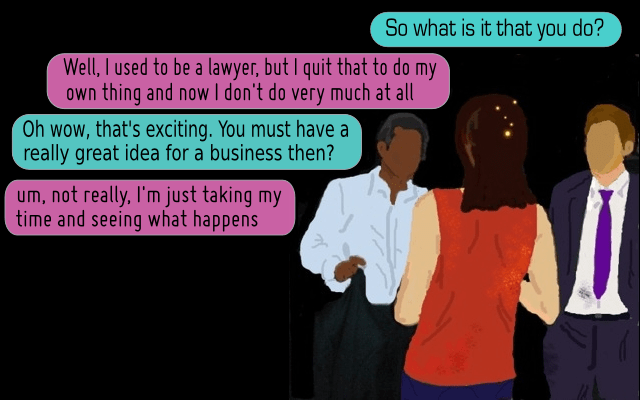
It’s interesting, there’s a definite assumption that if you’ve quit your well-paid job to start your own business, it must be because you’ve got this amazing idea.  I’ve noticed that people are really uncomfortable with the concept that you might just be mooching along seeing what comes your way.  In a social or networking context it goes a little something like this:

group shot 1

group shot 2

So without being in the slightest bit defensive, I thought it only right that I debunk a few unhelpful myths: 

the next-big-thing-myth

The next big thing is only the next big thing when it becomes the next big thing.  Got that?  Ok, let’s move on.

the we-planned-this-from-the start myth

Take a look at any of the internet big guns: they all started out as something pretty different from how they look now.

Pay-pal grew from a digital wallet solution.  Facebook started life as “Facemash”, a “hot or not” ratings site for Harvard students.  Amazon, if you remember, started off just selling books.  Google and You Tube spent years in the financial wilderness before finding a revenue model that turned a profit.

So don’t feel that in order to create a worthwhile business, you have to have figured out the path to global success from the very beginning.  Chances are you are going to have to radically change your concept, business model or both along the way, so your best approach is to be mindful of this from the outset and welcome the process.

the ability-to-predict-the-future myth

I’ve yet to meet someone who is in possession of the double-whammy combo of a crystal ball and hindsight.  Instead, we’re all members of the coulda, woulda, shoulda club.

I was supposed to go to a talk last month given by some important people in tech circles (Google, Groupon) on tech trends for 2013.  I couldn’t make it, but heard that it was interesting enough.  Conspicuously lacking in any substance though.  Mainly a rehash of what’s already out there with a bit of wishful thinking (Google+ anyone?  Anyone at all??).

I mean, between them, these guys have quite a lot invested in trying to work out what’s next for the tech juggernaut.  But they still don’t know for sure.  There were a lot of bets hedged.  So if they can’t predict the future, I’m sure as hell not going to try to.

the must-be-original myth

Sometimes, the best ideas are the ones that are derived from something that’s already out there.  I’m not advocating stealing anyone’s intellectual property.  I am saying there’s no point reinventing the wheel (unless you are in fact inventing a better wheel).  If you can improve on an existing product or service then that is just as legitimate a business as creating something totally new.

Look for the gaps in functionality, application, quality, service, cost, target markets.  There may well be a business hiding in between.

the gotta-change-the-world myth

Between them, Bono and Bob Geldof haven’t really managed to change even part of the world.  And they’ve got a heap of money and publicity behind them and they’ve been banging on about it for years.

Let’s be honest with ourselves for a second.  How many of us really believe that the iphone has actually changed the world?  Or Google?  Or Facebook?  They may have changed the way that we communicate, or obtain information, or interact, but they have not fundamentally changed the world.

If the strap line for the new iphone 6 is that it has brokered peace in the Middle East, then that’s a different story, but until then, we all need to get a bit of perspective.  (I actually think that unless Apple sorts out its woeful maps, the next iphone is more likely to incite violent land-grab insurgency, but I may be unduly pessimistic…).

the if-it’s-not-big-it’s-not-worthwhile myth

This one is the most damaging in my opinion.  I have no problem with people aiming high, if that is what inspires and encourages them.  But more often than not, this sense of having to have a big idea in order for your business to be valid, does nothing except cause paralysis.

There is nothing wrong with wanting to create a business that is just big enough for you.  If you look around you, that’s exactly what most businesses are.  Small.

If your goal is to create an empire, then by all means, sharpen your sabres and round up your troops.  But I view that brand of business colonialism as outdated and slightly distasteful.  To me it smacks of sitting in a leather swivel-chair with the obligatory white fluffy cat.

I think it’s ok to dabble, to start small and see what happens.  Without the pressure of a big idea, there is more room to grab the small but perfectly formed ones.  I see it in terms of the Crystal Maze.  Those teams in the Crystal Dome who aimed high ended up jumping around with arms flailing trying to catch the gold tokens being blown all over the place.  They lost.  The smart ones aimed lower and were able to gather up the already fallen tokens from the floor.  They won.

So that’s where you’ll find me, scrabbling around on the floor, picking up the overlooked ideas…

universal truths about beach holidays…

  • At any time of the day or night, at least one bar on the beach will be playing Bob Marley “Legend”.  And when it finishes, they’ll pass the CD to the bar on the left and it’ll be their turn to play it.  And so it shall continue, until the end of the world is upon us.
  • No matter how much you love the local food, after 4 days you will be desperate for something “normal”.  And that will probably involve pizza.
  • “Off the beaten track” has three stars and 283 reviews on Trip Advisor.
  • It is impossible to escape Gangnam Style.  So don’t even bother trying.
  • You will get the shits.  And it will be the day that you are going on a boat excursion to see the dolphins.  Or a 14 hour bus journey.
  • No matter how remote your location, you will always see at least a couple of locals wearing Chelsea and Man Utd football shirts.  And market sellers will always offer you “Asda price”.
  • 92% of your photos will be of the sunset.  The colours will never do justice to the real thing.  But you’ll keep taking photos, just in case.
  • The cheaper things are in local currency, the stingier you’ll become.  You will flip between haggling over the equivalent of 10p for an authentic handcrafted peace pipe, to leaving a 200% tip for dinner, because it only came to a fiver for three of you and you feel bad.
  • You will always feel slightly scared in the sea.  Of drowning, if you’re a girl.  Of fish nibbling your genitals, if you’re a guy.
  • You will try the local alcohol.  Just once.
  • You will fool yourself that the fact that you’ve chosen a place where activities are available (yoga, surfing, water-skiing) means that you will somehow magically be good at them.  Even though previously the closest you’ve ever come to surfing was that time you swam doggy paddle with a float at school.
  • Everyone wees in the sea.  Even if they say they’re just going to cool off, they will take the opportunity to have a wee.  And you can always spot them.  They’re the people who have a look of sublime concentration on their faces.
  • You will bring back at least 5 items of unworn clothing if you’re a girl.  And probably a pair of heels.  If you’re a guy, you won’t have taken more than 5 items of clothing in total, but you’ll still have to carry the heavier suitcase.
  • You never want to come home…

girl on girl action… networking for fierce women

Look away now if you are of a sensitive disposition, but I consider myself a feminist.  Brought up in an all-female, intelligent, self-sufficient household, this was only going one way.  It’s something I’m proud of.

But here’s the rub.  I have always instinctively shied away from any women-for-women type groups.  I think that it’s because I’ve never personally encountered any barriers to career progression or missed out on opportunities just because I’m a woman.  Or it’s because I can’t stand Loose Women.  One of the two.

That’s not to say that I can’t score a full house in City-boy chauvinist bingo.  Been eyed up when I’ve walked into a meeting room full of guys?  Yep.  Been bought champagne and inappropriate presents by clients when my male colleagues got diddly squat?  Yep.  Been complimented on my outfit/shoes, whilst they have a good gawp at my arse/legs.  Yep.  Been the only girl in meetings with male investment bankers taking turns to peacock (deliberate emphasis) and talking about strippers?  Bingo.

In spite of all that nonsense, I’ve always preferred to work with men.  I’ve found the dynamic more straight-forward, less loaded, less-mercurial.  I’ve felt freer to say what I think and to challenge decisions.  And my own experience has been that I’ve been encouraged, my abilities trusted and my contribution hugely recognised.

In contrast, I (and many of my friends) have had difficult working relationships with other women.  I’ve encountered pettiness, barbed put-downs and being undermined in front of colleagues and clients.  Friends have been held back from long-overdue promotions, been wickedly out-manoeuvred by colleagues they thought of as friends, and been given career-stunting appraisals from female bosses threatened by their talent.  It’s pure, childish playground ganging-up and the few rare times that I have cried at work have been because one of the other girls has been mean to me.

So every time I read something that says that we need more women on boards of companies or that it’s a disgrace that the pay gap still hasn’t shrunk, I whole-heartedly agree.  But I also know that we cannot lay the blame any more on the old boys’ network.  Because at least the boys, in the main, are promoting one another.

mean girls

What makes me sad (and it really does upset me), is that women are still holding other women back.  All the bloody time.  And it’s got to stop, ladies.  Because if we’re not helping one another, encouraging one another to succeed and supporting one another, then we sure as hell can’t whinge when the guys don’t do it for us.

I don’t get it.  It’s hard enough as it is, with the potent nature and nurture cocktail that women get of self-doubt, perfectionism, self-sacrifice and that feeling that we’re doing a terrible job of even pretending that we’re holding it together.  Why do we make it harder for one another?  Why do we make it so competitive, so unpleasant, so destructive?

My sister blames the Daily Mail.  It spews a constant stream of sanctimonious bile and judgment against women – at least any woman over a size 6. Denouncing single mothers as the root of all evil, working mothers as the cause of society’s demise, and voluntarily childless women as selfish freaks of nature.  And it has Liz Jones as its female figurehead.  A woman who has single-handedly done more to erode the advancement of womankind than any other person in my lifetime.  Thank you Daily Hell.  For nothing.

I don’t want it to be like this.  I don’t want to feel that in order to succeed I need to show that I have bigger balls than the guys.  I don’t want to perpetuate the sort of macho bullshit posturing that so many people (men and women) seem to think is ok in business.

I want to run a business surrounded by people I respect and who (hopefully) respect me.  I want to work with people who are smarter than me, because a wise man once told me that the only way your business gets better is if you hire people who are more talented than you.  I want to stay a normal human being and be nice and kind to people.  Because that’s how I am in the rest of my life, so why should I be any different at work?

bizzie birds

So… because I get that the only way to bring about change is to stop mithering and do something about it, I have decided, against my instincts, to join some women-focused business groups.  And I’ll admit to finding it difficult.  The Mack calls it my “bizzie birds” stuff.  It makes me want to punch him in the face.

I have contributed an article to a website called Women Unlimited which provides advice and support to female small business owners.  I had to check myself when I noticed that I was dumbing it down, in case the little women couldn’t understand the message.  Please take a look at their website, it is really accessible and encouraging

I went to a networking event hosted by The Next Women magazine.  It was a pitch evening for female co-founders to present their businesses to a panel of angel investors.  The keynote speakers were brilliant.  The investors were the real deal.  The ideas pitched were pretty much the same as at every other event I’ve been to recently, which made me quietly despair.  But the biggest revelation for me was that I realised I felt much more uncomfortable networking in a roomful of women than if it had been a mixed group or mostly guys.  I couldn’t help myself comparing shoes…

Shame on me.

Clearly, I still have some way to go.  I met a couple of great people and we have agreed to be cheerleaders for one another.  I’m going to stick with it, because I find it hilarious that even though women have an evolutionary advantage when it comes to making connections and being supportive, we are hideously bad at networking in business.

I think part of it is a feeling that we shouldn’t be asking for anyone’s help if we can’t offer something in return.  Men don’t have this insecurity.  I’ll give you an example.  The Mack went to a work thing recently where Chris Boardman (Olympic cyclist) was giving a speech.  The Mack thought nothing of collaring Chris afterwards and chewing his ear off.  The result, they’ve swapped contact details and I know that The Mack won’t hesitate to contact Chris in the future if he needs advice on the best bicycle clips.

I think we girls just need more practice.  Because the more that we all share our expertise and contacts and experience and wealth, the easier it will become for all of us.  And if it means that we have to be fierce (in a nice, Beyonce sort of way) and fearless about it, then fine – just give me a minute to get my best shoes on, and I’ll be right with you, sisters.

Just don’t make me watch Loose Women.

riding the Ferriss wheel…

Hands up how many of you have read The Four Hour Work Week by Timothy Ferriss?

Most of you.  As I thought.  Me too.

And now hands up how many of you have successfully created passive businesses which take up almost none of your time yet which generate enough monthly income to indulge in exciting leisure pursuits and world travel?

Nope, me neither.

Now, I ain’t knocking Mr Ferriss.  Not by any stretch.  I like him and his books.  In fact, The Mack and I have a shared fantasy about which one of us he would choose to marry if he had the choice.  Let’s just say I’m edging it.

a pied-piper for the 21st century 

For those who haven’t read the book, here’s a quick recap.  Tim (I feel ok calling him Tim, after all, we are to be married) says that it’s possible to escape the 9 to 5 grind, to outsource the admin side of your life to overseas virtual assistants and to develop businesses which run themselves, freeing you up to spend your life taking adventure holidays and learning new skills.  And in his book he shares his very detailed blueprint for how you do all this.

Wondrous, I hear you say.  Where do I sign?

I know.  Revolutionary.  I felt exactly the same way.  In fact, Tim was probably the single biggest catalyst for me leaving my job and adopting my new attitude towards the work/life balance (ditch the work, get a life).  He is smart, authoritative, engaging and his vision is hugely compelling.  Who wouldn’t want to follow him to the promised land?

I still think that the book is essential reading for anyone wanting to get more perspective and flexibility into their working life.  It’s just that in the intervening years since the first edition of the book came out (2007), an awful lot has changed in the world and I’m not sure whether the lifestyle oasis that Tim’s guiding us towards isn’t a bit of a mirage.

the abridged version

From a business perspective, it doesn’t make sense for Tim to scrap his existing template and revise his whole book to bring it bang up to date (and I appreciate that the 2011 edition does try to do a bit of that).  But I don’t have anything invested, so I’m going to do it for him.  It’s what any good wife would do…

Chapter 1.  Time Management and Productivity

I, like Tim, do not read newspapers (I’m a happy ignoramus).  I try not to spend hours on the world wide waste of time unless I’m actively looking for something I need.  I also try to limit my consumption of the general pointless amount of white noise and dross that makes up most of the (social) media nowadays.

Update:  The amount of blah blah seems to increase year on year.  Stop trying to ingest all the information that is available to you.  Be uber-selective.  If it really is news, you’ll hear about it.  Limit yourself to one Daily Mail Showbiz binge a month – any more than that and you might as well repeatedly smash your head against the nearest wall – research has shown it has the same effect on your brain.  

I also try to do important tasks in the morning, before I’ve found too much time for procrastination and diversion.  And I try to do them in chunks, so that there’s a greater chance I will complete them.  The alternative is a sorry trail of half-finished projects looking at me reproachfully as I try to slink out the door unnoticed at the end of the day.

Update: Everything nowadays is billed as urgent.  Don’t fall for it.  There is a world of difference between something that is important and urgent and something that is just urgent.  Be disciplined and stick to your guns.  Do your most important tasks before midday.  Then mentally take the rest of the day off.  You’ve earned it.

However, unlike Tim, I don’t find it necessary to limit responding to email only twice a day at allotted times.  I haven’t set up automated voicemail systems and email bounce-backs with instructions to my correspondents.  Nor have I bothered to set up timers that kick me off the internet if they feel I’ve been spending too long looking at dogs for adoption from Battersea.

Update: By all means, if you are an email/internet/facebook/twitter/angry birds addict and your attention span without Ritalin is that of an ADHD gnat, then might I suggest the radical move of not opening those applications until you’ve finished your work.  But unless you are a really, really busy important person (and, in fairness, Tim is probably one of those), I wouldn’t bother with installing a fortress-like time management regime – it mainly makes you look pompous and, ironically, like you have too much time on your hands.

Chapter 2.  Outsource the Boring Stuff

When my younger sister was out of work and I was working crazy hours, I used to pay her to do those errands that I never had time for.  It was the perfect arrangement.  She got a bit of cash to tide her over, I had dry-cleaned clothes and food in the house and my bills were paid on time.  It was what I imagine having a wife must be like.

So I am all in favour of paying someone to help you with tasks if your time is taken up elsewhere or if it is better spent doing other things.

Tim recommends using a virtual assistant.  Mainly based in India or increasingly the Philippines, you pay your VA company an hourly rate (you can bulk-buy time to save money) and you are assigned an assistant who will perform admin, research or similar tasks for you.

Great idea and, back in 2007, probably quite exciting places for a young, bright graduate in those countries to work.  Fast-forward 5 years and it seems as though those graduates are being funneled into jobs with Google and Apple instead.  Hmmm.

Update: Recent experience with some of the big firms (AskSunday, Brickwork) has been underwhelming.  The assistants have struggled to cope with anything but incredibly basic web-research and cut-and-paste tasks, one explaining that he “was not skilled in summarising or tables”.  Okay then.  Unless you get lucky and find a good one, at around $12/hour, I don’t think it’s worth it for all but the most routine and boring research tasks that you just cannot make yourself do.

Some of my friends use Elance, oDesk and 99designs to find freelance contractors.  Again, reviews have been mixed, so I wouldn’t rely on these outsourced services for anything that is commercially important or time-sensitive.

Chapter 3.  Passive Aggressive Business Building

I really want to believe that it’s possible to create a business that isn’t resource heavy, that can just live on in the background, quietly raking in the money whilst you sun yourself in Acapulco (erm, wasn’t that the plot to that weird Phil Collins film, Buster…?).

And believe you me, I have dissected the step-by-step guide on how to do this, from researching a niche market, picking your product, testing uptake, figuring out how to automate the fulfillment process etc.  And I think that all of this is really sound advice for any start-up business.

But the bottom line is, I think the concept of a passive business is pretty much a holy grail situation.  If found, it’s a happy accident and you’re going to be rich and famous.  One example I came across recently was a former sports fan forum site that made millions for its owners when they added affiliate links to betting sites.  Genius.  But pure fluke.

Most businesses take years, time, money, commitment and aggressive focus to deliver any sort of real return. This isn’t a get-rich-quick solution, no matter how it’s presented.

The way I look at it is through Tim’s own path.  He learned the lessons presented in the book through doing things the hard way.  He’s developed some sensible principles to shortcut many of the hurdles he encountered.  But the fact is that he now makes his money on the back of his books, which required huge amounts of research, time, effort, promotion etc., etc.  So don’t expect instant success on an £11.99 paperback investment.

Update: Read Tim’s book for overall inspiration and to get a feel for how you might build out a business.  Take the building blocks from 4HWW around ideation of your business (it’s always easier to sell what you know, so what are your interests? what opportunities do you spot within your interest group?), assumption testing (cheap marketing and advertising tools, the basics on adwords, launch pages etc.), the 80/20 rule (focus on the 20% of customers who represent 80% of your sales), but expect to put some hard graft in too. 

Epilogue

4HWW is a best-seller for a reason.  It’s an easily digestible introduction to engineering a better working life.  I think it’s particularly helpful for us corporate-whores who struggle to see a life outside of the big box.  So if you’re looking to make lifestyle resolutions this New Year, then get a copy for Christmas.

Just keep in mind when you’re reading and dreamlining that it’s not a miracle overnight prescription.  Tim makes it sound so easy, but I can promise you that it’s a bit of a slog on the other side.  However, given that I’m writing this from a beach bar in Goa, I’d definitely agree that the section on mini-retirement definitely has something going for it…

karma drama continues…

I’ve come to the conclusion that I must have done something truly terrible to anger the Indian gods.  I have no idea what, but if anyone knows a way of paying baksheesh directly to Ganesh and his pals to clear my debt, that would be a great help.

Regular readers will remember that I’ve already had a bit of a run in with Jet Airways, who wouldn’t let me use the inbound portion of my return flight, because I couldn’t make the outbound flight.  So I ended up forfeiting the £500 flight I’d already paid for and paying another £300 to get my seat back on the flight home.

Well, I didn’t think that it was possible to top that business wizardry.  Oh me of little faith…

Right, so I’m in possession of a Goa – Mumbai – London flight.  But I’ve decided that I’m going to spend a week or so in Kerala.  I’m going to experience the delights of the Indian rail system and take a train from Margao in Goa to Kochi in Kerala.  It’s 12 hours.  I’ve given it careful consideration and decided that air conditioning and veg food is the optimum combination for that journey.

It doesn’t make sense to fly back from Kerala to Goa and then on to Mumbai.  In fact you can’t – you have to fly Kerala – Bangalore – Goa – Mumbai.  Rubbish.  So I’ve paid for a flight direct from Kerala to Mumbai and I’ll pick up my flight back to London from there.

Simples, right?

Not exactly.  What you actually get is a scene straight from an incredibly well-crafted psychological thriller – one of those ones where the clever villain creates such a web of chaos and misdirection that it makes the protagonist start to doubt their sanity.

the true cost of flying

Given my history with Jet, I raise my concerns that they’d somehow cancel my Mumbai – London flight if I didn’t get my Goa – Mumbai flight.  The local travel agent in Goa laughs at the suggestion.  Don’t worry, he says, you can just cancel your domestic flight.  It will cost you about 950 rupees (£10).  Easy breezy.

So I call Jet Airways at midday, thinking I’ll get it done before I go and lounge on the beach.  2 hours later and I’m still on the phone with them.  Here’s a quick recap, for those unlucky enough not to have been on the call with me:

–       disconnections x 3 times

–       explaining that there are 2 separate passengers, both with the same surname, under 2 different e-tickets x 4 times

–       learning that it is not possible to simply cancel the Goa – Mumbai flight.  You have the option of cancelling the entire Goa – Mumbai – London flight (that, remember, you’ve already paid £800 total for by now) – you will get £80 back in refund and then you have to purchase a new Mumbai – London ticket.  Err, not that appealing, but thanks for the offer.

–       alternatively, you can pay a re-routing charge of £100 per passenger for the privilege of NOT travelling on the 1-hour Goa – Mumbai flight.

So, only ten times the cost that the travel agent told you… Bargain.

By this point, you have started to understand that there is nothing that you can do.  Jet will always win.  Their illogic knows no bounds and you, mere mortal that you are, are no match for their cunning.  You agree to pay the re-routing charge on a flight that you are not re-routing anywhere in the slightest.  At least then it’s done.  So, you send your sis off to the beach whilst you deal with the payment.

But wait, there’s another problem.  Now it seems that you cannot actually get them to take your payment.  The credit card won’t go through.  But it isn’t a problem with the card.  Too easy.  No, the problem is that your sister’s ticket was issued in the name of Miss Alexandra Hughes.  Pretty standard you might think – all international airlines use the same title for unmarried women.

Oh yes, madam, says the Jet customer service rep.  Only with Jet, the title “Miss” can only be used for children.  The ticket should have been issued as Ms Alexandra Hughes.  The “Miss” title brings it up as a child fare on their system and it won’t process the payment.  Don’t worry – the fare that you have paid is an adult fare and the cancellation of the Goa – Mumbai flight has been made, it is only the payment that won’t go through.

And no, even though they are the airline issuing the tickets, there is no way for them to change the “Miss” to a “Ms” on their system.  “There is no button to allow for that”

Does anyone understand that – even a word of that?  Don’t even go there, you’ll give yourself an aneurism with the effort of mentally contorting yourself.  And you’ll still be nowhere near.

And of course there is no other solution – you’ll have to go to an airport counter or one of Jet’s city offices to make the payment.  The nearest one is a 3 hour, £20 round-trip taxi ride away.

Ok, so that’s a pain in the arse, but you’ll be in a city in a few days when you go to Kerala, so if Jet can just cancel those changes, you’ll go to their office in Kochi and deal with it all there.

Oh you English are so funny!  That’s not how the game works.  There is no way to reverse the flight cancellations now.  It doesn’t matter that it’s not your fault that Jet can’t process your payment and that there was no way of knowing that this problem even existed until after they had already processed the cancellations.  It’s done now.

And now for the finale: you have to complete payment on the cancellations within 18 hours, otherwise you will have to pay again and you risk your international flight being cancelled in the meantime.  And it is now 2pm where you are and the airport desk closes at 6pm.  So you’d better hurry along.

And you do.  You run to the beach to tell your sis through your tears that you have to do an airport run.  Yep, right now.  That, once again, the fuckers have managed to trap you in their fiendish plot to break your will.  And you grab your passports, both phones, your tickets and credit cards and you get in a taxi.

I get car sick at the best of times.  Wasting a precious day of Goan sunshine to sit in a stuffy taxi for 3 hours was not how I envisaged my mini-retirement.

Then there was the nerve-wracking hour spent at the Jet Airways counter outside Dabolim Airport, wondering what new twist they would come up with to test me.  The elation at finally getting the new tickets issued – entirely unwarranted – it’s not as though I haven’t now paid for them three times over…  Being pulled over by the airport police so they could extort Prakash, my taxi driver, some pitiable amount (I couldn’t bear to tell him that it was my fault: that I was the jinx).  The celebratory BaskinRobbins ice-creams I bought for us both on the drive home (world class chocolate for Prakash, butterscotch ribbon and pralines and cream for me).  The anxious look on my sister’s face as I arrived back at the beach – she thought Jet had kidnapped me – and I’d left without leaving the room key at reception, so she was stranded, on the beach, with no money, no phone and a day’s worth of food and drinks on the tab.  Happy holiday.

I’m really hoping that’s the end of it.  I feel like I’ve paid my dues.  But if anyone could put in a good word for me with the deities, just in case, I’d be very grateful.  I’m planning a houseboat trip on the Keralan backwaters next week……